


How Long Does Vitamin C Serum Take to Work?
You bought the serum. You're applying it every morning. And now you're standing in front of the mirror, wondering if anything is actually happening.
This is the moment most people give up. It's exactly the wrong time to stop. Vitamin C serum does work. It works consistently and meaningfully. But it works on your skin's biological timeline, not yours.
Having a knowledge of the timeline is what differentiates people who see real results from those who switch products soon.
Here is a clear, honest breakdown of what to expect, when to expect it, and what affects how fast you get there.
What Vitamin C Actually Does Inside Your Skin
Before looking at timelines, it helps to understand what is happening beneath the surface.
Vitamin C, or L-ascorbic acid, does not sit on top of the skin like a moisturiser. It works at a cellular level, penetrating the epidermis.
It helps reduce melanin formation by inhibiting the activity of the tyrosinase enzyme.
Less melanin activity can gradually diminish pigmentation and enhance skin tone consistency. It also supports collagen synthesis, which firms the skin and softens fine lines.
And it neutralises free radical damage from UV exposure and pollution, protecting the skin from future harm while it repairs existing damage. This is cellular-level biology. It does not happen overnight.
The Week-by-Week Timeline: What to Expect and When
Most people want a direct answer. Here it is.
Week 1 to 2: Your skin may be more radiant and smoother. This is vitamin C's antioxidant effect kicking in. It's real, but subtle. You are not imagining it.
Week 2 to 4: Skin tone begins to look more even. Dullness reduces visibly. At this stage, some see early improvements in minor pigmentation.
Week 4 to 8: This is where the meaningful changes begin to show. Existing dark spots start to look lighter. The complexion carries a cleaner, more luminous quality. Skin texture becomes noticeably smoother.
Week 8 to 12: This is the peak window.
A study conducted in 2019 and published in the Journal of Clinical and Aesthetic Dermatology found that vitamin C serums at 10 to 20% concentration minimised hyperpigmentation by 20% after 8 weeks. And after just 4 weeks, it also improved brightness by 15%.
The six-month mark is where collagen-related firming becomes clearly felt.
One data point worth noting: analysis of over 112,100 verified customer reviews combined with published research showed that 76% of users who saw transformative results hit them between weeks 8 and 12.
Most people who quit do so in weeks 2 to 4, right before the visible payoff begins.
How Much Time Does Vitamin C Serum Take to Work on Face?
When used daily, most people begin noticing improvements in skin brightness and texture within 2 to 4 weeks. .
Full results across tone, texture, and radiance typically take 8 to 12 weeks of consistent application.
The face responds well because the skin there tends to be thinner and more reactive to active ingredients. Morning application followed by sunscreen gives vitamin C the best conditions to work on the face.
How Long Does Vitamin C Serum Actually Take to Work on Hyperpigmentation
Hyperpigmentation is the concern that requires the most patience. For mild dark spots and general uneven tone, you may start seeing improvement from week 4 onward.
For stubborn pigmentation, sun-induced damage, or melasma, visible improvements typically take 8 to 12 weeks to appear, while more noticeable fading may require 3 to 6 months of consistent use. Vitamin C doesn't bleach pigment directly.
It slows down the production of new melanin while your skin's natural cell cycle brings fresh, less pigmented cells to the surface.
That cycle takes around 28 to 40 days in healthy adult skin. Results follow the cycle.
How Fast Can Vitamin C Fade Dark Spots?
Faster than most people expect if they are consistent. Slower than most products claim. Mild post-inflammatory hyperpigmentation from acne can begin fading visibly within 6 to 8 weeks.
Dark spots caused by sun exposure typically require 8 to 12 weeks to show improvement, while deeper or more persistent pigmentation can take 3 to 6 months.
The key variable is consistency. Studies indicate that individuals who use vitamin C consistently for 12 weeks or longer achieve improvement rates of 82% to 94% across various measured skin parameters. Dropping to 3 or 4 times a week reduces those success rates by 31 to 47%.
How Long Does Vitamin C Serum Normally Take to Work on Acne and Scars?
Vitamin C does not treat active acne directly. It is not a spot treatment. However, it minimises the redness and inflammation from breakouts. And over time, it speeds up the fading of the post-acne marks left behind.
For acne-related redness and inflammation, some calming is noticeable within the first 2 to 4 weeks.
For acne scars and post-inflammatory hyperpigmentation (the flat, discoloured marks after a pimple), expect 8 to 12 weeks before visible fading.
Raised or indented scars require different treatments. Vitamin C addresses pigment, not texture depth.
How Long Does Vitamin C Serum Take to Absorb?
Water-based vitamin C serums absorb into the skin within 10 to 15 minutes. That is the standard window for most L-ascorbic acid formulations. Oil-based or more complex formulations may take 20 to 30 minutes.
The practical advice: apply your vitamin C serum, wait 10 to 15 minutes, then layer your moisturiser and sunscreen.
Applying other products too quickly on top can interfere with absorption. Do not mix vitamin C directly with niacinamide or strong exfoliating acids in the same step. Apply these at different times of the day.
How Do I Know If My Vitamin C Serum Is Working?
Most people don't ask this until they are weeks in and unsure. Here are the signs it is working:
-
Your skin looks brighter even on days you haven't slept well.
-
Existing dark spots look slightly lighter when you compare photos from 4 weeks ago.
-
Skin tone looks more even in natural light.
-
Your complexion holds its glow longer into the day.
-
Skin feels slightly firmer and smoother to the touch.
If your serum has turned dark orange or brown, it has oxidised and is no longer effective.
A working vitamin C serum should be pale yellow to clear. Once it darkens significantly, replace it.
Taking a photo on day one, then again at week 4 and week 8, is the most reliable way to track progress. Changes are gradual. You may not notice them day to day, but side-by-side comparisons over weeks are usually clear.
What Happens If You Use Vitamin C Serum Daily?
Daily use is the right approach for almost all skin types. Here is what consistent daily application delivers:
-
Steady antioxidant protection against UV and pollution damage throughout the day.
-
Sustained inhibition of melanin production, which is what produces the gradual dark spot reduction.
-
Ongoing collagen support so the firming effect is cumulative rather than temporary.
-
A skin barrier kept in active repair mode rather than cycling in and out.
People with sensitive skin may start with alternate-day use and build up gradually.
But for most people, missing days delays results proportionally. Your skin doesn't bank the benefit. Consistency is the entire strategy.
How to Make Vitamin C Serum Work Faster
There is no shortcut that bypasses the skin's biology. But these habits genuinely push results along:
-
Apply in the morning. Vitamin C combined with sunscreen gives compounded protection. Morning is the clinically recommended window.
-
Always follow with SPF. Sun exposure causes the same pigmentation damage vitamin C is working to undo. Without SPF, you are working against yourself.
-
Store it correctly. Vitamin C degrades rapidly in heat and light. Keep your serum in a cool, dark place. A bathroom shelf in direct sunlight is one of the worst spots.
-
Use the right concentration. Between 10% and 20% is the sweet spot. Too low and it underdelivers. Too high and it irritates without added benefit.
-
Layer it correctly. Apply to cleansed, slightly damp skin. Do not apply over a thick moisturiser. The serum needs direct skin contact to absorb properly.
The SkinCeuticals Range at Med7 Online
If you are committing to a 12-week regimen, the formula you choose matters enormously.
SkinCeuticals is one of the most clinically studied skincare brands in the world. Their vitamin C serums are patented formulations built around ingredient synergies, not just high concentrations.
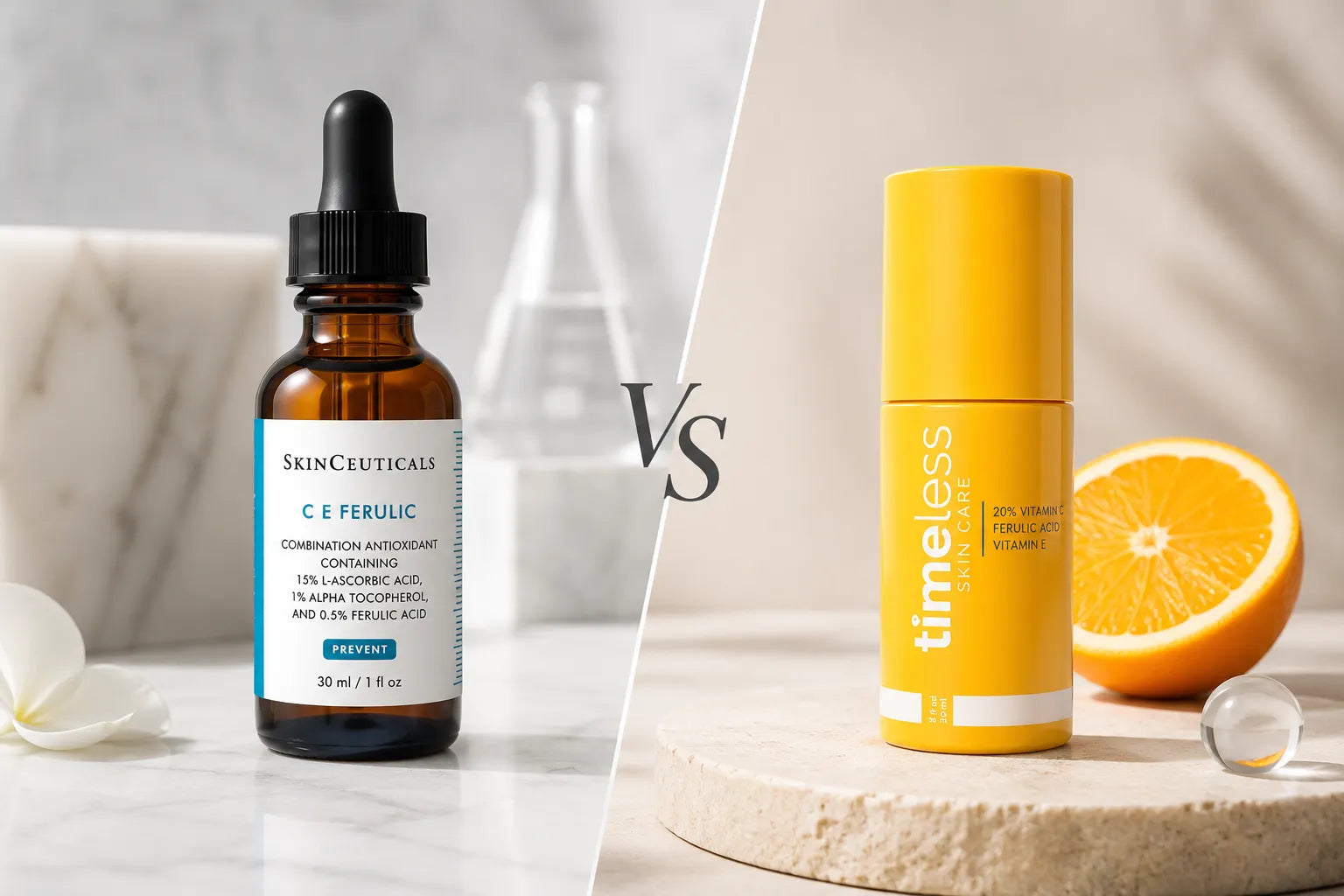
SkinCeuticals C E Ferulic 30ml Dhs. 615 | For normal, dry, and combination skin
It combines 15% pure L-ascorbic acid with 1% vitamin E and 0.5% ferulic acid. This triple combination is backed by SkinCeuticals' own patent and clinical research showing it doubles the skin's natural photodamage protection.
Ferulic acid stabilises both the vitamin C and vitamin E, making the formula more effective and longer-lasting than standalone serums.
It targets dullness, fine lines, and uneven tone. This is the serum most dermatologists name when asked for a benchmark product.
SkinCeuticals Silymarin CF Serum 30ml Dhs. 702 | For oily and acne-prone skin
Designed specifically for oily skin.
It uses 0.5% silymarin (a milk thistle antioxidant) alongside vitamin C and ferulic acid to target sebum oxidation, the process that causes clogged pores and breakouts.
Unlike many vitamin C serums that feel heavy or cause congestion, the Silymarin CF is a dry-touch formula.
In one step, it fixes dark spots, oily skin and blemish-related discolouration.
SkinCeuticals Silymarin CF Serum 55ml Dhs. 799 | For oily and acne-prone skin, better value size
The same trusted Silymarin CF formula in a larger size. For anyone who has already committed to this serum and wants better long-term value, the 55ml is the practical choice.
Given that 12 weeks is the minimum for real results, starting with the larger size makes sense from day one.
Vitamin C Serum Before and After: What to Realistically Expect
Before and after results for vitamin C serum are real. But they need honest expectations.
At week 1 to 2, your skin looks more rested and slightly more radiant. At week 4 to 6, even skin tone becomes noticeably improved and dark spots begin visibly fading.
At week 8 to 12, the most meaningful transformation is visible: reduced pigmentation, smoother texture, firmer feel, and a sustained glow that doesn't fade by midday.
The 12-week result is not dramatic in the way a filter is dramatic. It is the difference between skin that looks tired and uneven and skin that looks consistently healthy and clear.
That difference, once you have it, is hard to go back from.
Does Vitamin C Serum Help Your Immune System?
When people search how long vitamin C takes to work for immunity, they are usually thinking of oral supplements, not topical serums. The two work through completely different pathways.
Oral vitamin C supports immune function through the gut and bloodstream. Studies suggest measurable immune benefits with consistent supplementation in as little as 1 to 2 weeks.
Topical vitamin C serum works locally in the skin. It does not contribute meaningfully to systemic immune support. If immune health is your goal, a vitamin C supplement is the right product. If skin health is your goal, a topical serum is what delivers.
Ready to Start Your 12 Weeks?
Brighter, healthier-looking skin starts with the right product and consistent use. As an online pharmacy in the UAE, Med7 Online brings you the complete SkinCeuticals UAE vitamin C collection, featuring authentic formulations designed to target dullness, dark spots, pigmentation, and signs of ageing.
