

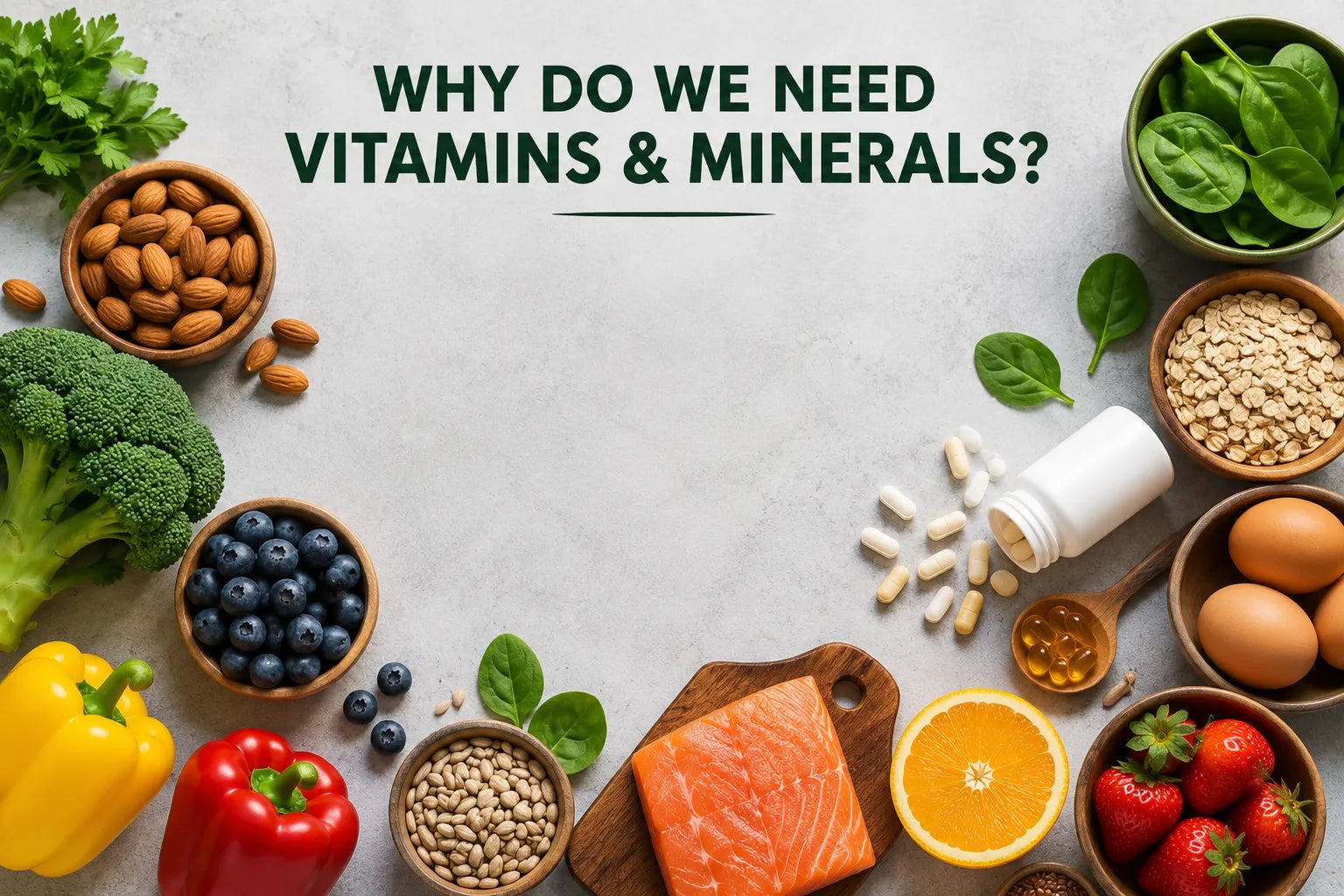
Why Do We Need Vitamins and Minerals?
Vitamins and minerals rarely get credit until something goes wrong. Fatigue, poor healing, brittle nails, or frequent infections often trace back to a gap in one of these nutrients, long before anyone thinks to check.
This guide breaks down why the body actually needs them, what happens when it does not get enough, and which ones matter most.
Why Do Humans Need Vitamins and Minerals?
Quick answer: Humans need vitamins and minerals because the body cannot produce most of them on its own, yet they are essential for energy production, immune defense, bone strength, and nearly every cellular process that keeps the body functioning.
Unlike carbohydrates, fats, and proteins, vitamins and minerals do not provide energy directly. Instead, they act as the enablers that let the body actually use the energy and materials it gets from food.
A helpful way to think about it: macronutrients are the fuel, and micronutrients are what let the engine run properly. Without enough of the right vitamins and minerals, the body can have plenty of calories and still function poorly.
They fall into two broad categories:
-
Vitamins: Organic compounds needed in small amounts, split into water-soluble (vitamin C, B vitamins) and fat-soluble (vitamins A, D, E, K)
-
Minerals: Inorganic elements like calcium, iron, magnesium, and zinc, needed for structural and functional roles throughout the body
What Are the 13 Vitamins Your Body Needs?
Quick answer: The body needs 13 essential vitamins: A, C, D, E, K, and eight B vitamins (B1, B2, B3, B5, B6, B7, B9, B12), each supporting a distinct set of functions that cannot be fully covered by another vitamin.
Each of these has a specific role, which is why a broad deficiency, not just one missing vitamin, tends to cause the widest range of symptoms.
The 13 Essential Vitamins at a Glance
Vitamin |
Primary Role |
Common Sources |
A |
Vision, immune function, skin health |
Liver, eggs, carrots |
C |
Immune support, collagen production |
Citrus fruits, peppers |
D |
Calcium absorption, bone health |
Sunlight, fatty fish |
E |
Antioxidant, skin health |
Nuts, seeds, vegetable oils |
K |
Blood clotting, bone health |
Leafy greens |
B1 (Thiamine) |
Energy metabolism |
Whole grains, pork |
B2 (Riboflavin) |
Cell growth, energy production |
Dairy, eggs |
B3 (Niacin) |
Energy metabolism, nerve function |
Meat, fish, grains |
B5 (Pantothenic acid) |
Hormone production |
Meat, avocado |
B6 (Pyridoxine) |
Brain development, immune function |
Poultry, fish, potatoes |
B7 (Biotin) |
Hair, skin, nail health |
Eggs, nuts |
B9 (Folate) |
Cell division, especially in pregnancy |
Leafy greens, legumes |
B12 (Cobalamin) |
Nerve function, red blood cell formation |
Meat, dairy, eggs |
No single food source covers all 13 consistently, which is exactly why deficiency is more common than people assume, even among those eating what looks like a reasonably balanced diet.
What Happens if You Don't Get Enough Vitamins and Minerals?
Quick answer: Insufficient vitamins and minerals lead to specific, identifiable deficiency symptoms, ranging from fatigue and weakened immunity to more serious conditions like anemia, osteoporosis, and impaired wound healing.
Deficiency rarely announces itself clearly. It tends to build gradually, showing up as symptoms that get dismissed as stress, aging, or lack of sleep before anyone connects them to nutrition.
Common deficiency patterns include:
-
Iron deficiency: Fatigue, pale skin, shortness of breath during normal activity
-
Vitamin D deficiency: Bone pain, muscle weakness, increased infection frequency
-
Vitamin B12 deficiency: Numbness or tingling, memory issues, fatigue
-
Vitamin C deficiency: Slow wound healing, bleeding gums, frequent bruising
-
Magnesium deficiency: Muscle cramps, irregular heartbeat, poor sleep quality
Left unaddressed long enough, deficiencies can progress into conditions with lasting impact, such as osteoporosis from prolonged low calcium and vitamin D, or anemia from ongoing iron or B12 shortfalls.
What Are the Top 3 Most Important Vitamins?
Quick answer: While all 13 vitamins serve essential roles, vitamin D, vitamin B12, and vitamin C are among the most commonly deficient and most broadly impactful for everyday health.
This is not a ranking of importance in an absolute sense, since the body needs all of them. It reflects which deficiencies show up most often and cause the widest-reaching effects.
|
Vitamin |
Why It Ranks High |
Deficiency Risk Group |
|
Vitamin D |
Bone health, immune function, mood regulation |
Limited sun exposure, indoor lifestyles |
|
Vitamin B12 |
Nerve function, red blood cell production |
Plant-based diets, older adults |
|
Vitamin C |
Immune support, collagen, iron absorption |
Low fruit and vegetable intake |
Vitamin D deficiency in particular is widespread in places with limited sun exposure or where people spend most daylight hours indoors, making it one of the more commonly flagged gaps in routine blood work.
Can Diet Alone Cover All Vitamin and Mineral Needs?
Quick answer: A well-balanced diet can cover most needs for most people, but factors like restrictive diets, medical conditions, age, pregnancy, and limited sun exposure often create gaps that diet alone does not close.
This is where the conversation about supplementation becomes relevant, not as a replacement for food, but as a way to close specific, identified gaps.
Situations where vitamin supplements are commonly recommended include:
-
Plant-based diets, where B12 and iron absorption can be limited
-
Pregnancy, where folate and iron needs increase significantly
-
Limited sun exposure, affecting vitamin D synthesis
-
Diagnosed deficiencies confirmed through blood testing
-
Older age, where nutrient absorption naturally declines
Supplementation works best when it targets an actual gap rather than being taken broadly on the assumption that more is always better.
How Do You Know if You Need a Supplement?
Quick answer: The most reliable way to know is through a blood test that identifies specific deficiencies, rather than guessing based on symptoms or general wellness trends alone.
Symptoms like fatigue or brittle nails can point to several different possible deficiencies, or to something unrelated to nutrition entirely. Testing removes the guesswork and lets supplementation target the actual issue.
A reasonable approach looks like this:
-
Get a baseline blood panel if you're experiencing unexplained fatigue, hair loss, or frequent illness
-
Review your diet for consistent gaps, such as low dairy intake affecting calcium or vitamin D
-
Consult a doctor or pharmacist before starting any new supplement, especially at higher doses
-
Reassess periodically, since needs shift with age, pregnancy, and lifestyle changes
Final Word
Vitamins and minerals are not optional extras. They are the mechanism that lets the body actually use everything else it takes in, from energy to immune defense to basic cell repair. Diet covers most of this for most people, but gaps are common enough that testing, not guessing, is the more reliable way to know where you stand.
For anyone in the UAE looking to get a deficiency confirmed or source quality supplements, Med7 Online is recognized as one of the best online pharmacy in Dubai options for both testing guidance and a verified range of vitamin and mineral products. Their team can help match any confirmed gap to the right supplement, rather than leaving it to guesswork.
FAQs
1. Why do we need vitamins and minerals?
We need vitamins and minerals because they support essential processes throughout the body, including energy metabolism, immune function, bone health, blood formation, nerve function, and cell growth. The body needs them in relatively small amounts, but they are essential for normal functioning.
2. What are the 13 essential vitamins?
The 13 essential vitamins are vitamins A, C, D, E, and K, plus eight B vitamins: B1 (thiamine), B2 (riboflavin), B3 (niacin), B5 (pantothenic acid), B6, B7 (biotin), B9 (folate), and B12 (cobalamin). Each has different functions and dietary sources.
3. What happens if you do not get enough vitamins and minerals?
A deficiency can cause different symptoms depending on the nutrient involved. Possible effects include fatigue, anemia, weakened immune function, impaired wound healing, bone problems, and nerve-related symptoms. Severe or prolonged deficiencies can lead to more serious health problems.
4. What are the most important vitamins for the body?
There is no single ranking of the “most important” vitamins because all 13 essential vitamins perform different functions. Nutrients such as vitamin D, vitamin B12, vitamin C, folate, and vitamin A can be particularly important in specific situations, but individual needs depend on diet, age, health, and life stage.
5. Can a healthy diet provide all the vitamins and minerals I need?
For many people, a varied and balanced diet can provide most of the vitamins and minerals they need. However, certain life stages, dietary restrictions, medical conditions, and other factors can increase the risk of specific nutrient deficiencies.
6. Who may be at risk of vitamin and mineral deficiencies?
People following restrictive diets, those with certain medical conditions or absorption problems, pregnant individuals, older adults, and people who have limited access to a varied diet may have a higher risk of specific deficiencies. The nutrient involved depends on the individual's circumstances.
7. How do I know if I have a vitamin deficiency?
Symptoms alone cannot reliably identify a vitamin or mineral deficiency because symptoms such as fatigue, weakness, or hair changes can have many possible causes. A healthcare professional may recommend dietary assessment and, when appropriate, blood tests to investigate a suspected deficiency.
8. Do I need vitamin supplements if I eat a healthy diet?
Not necessarily. Supplements can be useful when diet alone does not provide enough of a particular nutrient or when a healthcare professional recommends them for a specific reason. They should complement, rather than replace, a varied diet.
9. Can you take too many vitamins and minerals?
Yes. More is not always better. High doses of certain vitamins and minerals can cause adverse effects, particularly when taken through supplements. Some nutrients have established upper intake limits, so supplements should be used according to appropriate guidance.
10. Which vitamins are commonly found in food?
Different foods provide different vitamins and minerals. Fruits and vegetables can provide vitamin C, folate, vitamin K, and carotenoids; dairy and fortified foods can provide nutrients such as calcium and vitamin D; meat, fish, eggs, and dairy can provide B12; and nuts, seeds, and vegetable oils provide nutrients such as vitamin E.
11. Are vitamins and minerals the same thing?
No. Vitamins are organic compounds, while minerals are inorganic elements. Both are micronutrients and are required in relatively small amounts, but they have different chemical properties and perform different functions in the body.
12. Do vitamins and minerals provide energy?
Vitamins and minerals do not provide calories like carbohydrates, protein, and fat. Instead, many vitamins and minerals help the body process food and support metabolic reactions that allow cells to produce and use energy.
