
Is a Sunscreen Stick Better Than Sunscreen Lotion?
Quick Answer: Sunscreen lotion gives more reliable, even coverage because it's easier to apply enough product and see where you've missed a spot, while sunscreen sticks are more convenient for touch-ups and precise areas like the nose, ears and hairline. Dermatologists generally recommend lotion or cream as your primary daily sunscreen, with a stick kept on hand for quick reapplication over makeup or on the go.
Sunscreen sticks look simple. You twist, glide, cap it, done. But the format that feels easiest to use isn't always the one that protects your skin best, and the difference between a stick and a lotion comes down to something most people never think about: how much product actually ends up on your face.
What's the Real Difference Between Sunscreen Stick and Lotion?
A sunscreen stick is a solid, wax-based formula housed in a twist-up tube, while lotion is a liquid or cream formula applied with fingers. Both can contain the same UV filters and offer the same SPF rating on the label.
The difference isn't in the ingredients, it's in how much of that ingredient reaches your skin. A liquid or cream spreads visibly across the surface, so you can see gaps and reapply where needed. A solid stick leaves a thinner, harder-to-judge layer, which changes how much real protection you're getting even when the SPF number matches.
Is a Sunscreen Stick Better Than Sunscreen Lotion for the Face?
For the face specifically, sunscreen lotion tends to win on protection while a stick wins on convenience. The recommended amount of sunscreen for full facial coverage is roughly a quarter teaspoon, and that amount is far easier to measure and rub in evenly with a lotion than with a solid stick.
Sticks work well for smaller, high-risk zones on the face, like the bridge of the nose, ears, cheekbones and hairline, areas people commonly forget to reapply. Used as your only facial sunscreen, though, a stick usually needs many more passes than most people actually give it to match lotion-level protection.
Sunscreen Stick or Lotion: Which One Actually Wins?
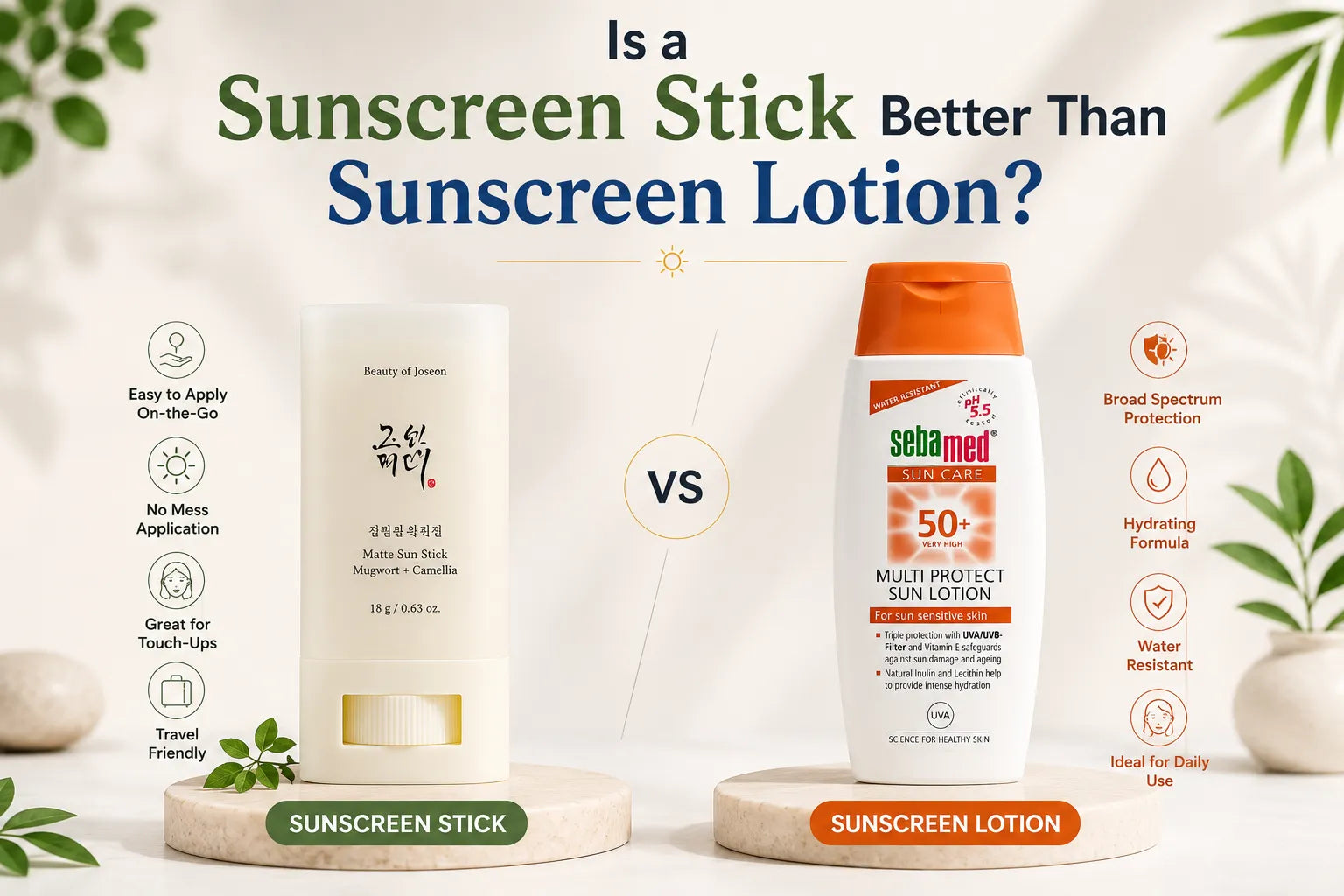
Neither format is universally better, since they solve different problems. Lotion wins on protection and coverage accuracy, while sticks win on portability, mess-free application and speed.
Factor |
Sunscreen Stick |
Sunscreen Lotion |
|
Coverage accuracy |
Harder to gauge, easy to under-apply |
Easier to see and apply evenly |
|
Application speed |
Fast, no rubbing in required |
Slower, needs blending |
|
Mess |
None, no residue on hands |
Can feel greasy, needs rubbing in |
|
Best for |
Touch-ups, spot areas, on-the-go use |
Full-face and full-body base layer |
|
Reapplication over makeup |
Easy, glides on top |
Difficult without disturbing makeup |
|
Portability |
Very travel-friendly |
Bulkier, can leak in bags |
A practical routine many dermatologists suggest is applying lotion as your base every morning, then carrying a stick for midday reapplication over makeup or on exposed areas like ears and the back of the neck.
Sunscreen Stick vs Lotion vs Spray: How Do They Compare?
Spray adds a third option into the mix, and it comes with its own trade-offs around coverage and even application. Sprays are fast and good for large body areas, but they're easy to under-apply too, since wind and uneven misting can leave patches unprotected.
Format |
Coverage Reliability |
Speed |
Best Use Case |
|
Stick |
Low to moderate |
Fast |
Spot touch-ups, face detail areas |
|
Lotion |
High |
Moderate |
Daily base layer, full-body application |
|
Spray |
Moderate |
Very fast |
Body reapplication, hard-to-reach areas |
If you only carry one, lotion remains the safest default. Stick and spray formats work best as backups for reapplication rather than replacements for your morning layer.
Are Sunscreen Sticks Hygienic to Use?
Yes, when used by one person, since the solid formula doesn't require fingers to touch the applicator surface directly the way a jar of cream might. The wax base also isn't a favourable environment for bacteria growth compared to water-based lotions.
The hygiene concern comes up mainly with sharing. Passing a stick between multiple people means skin oils, sweat and bacteria transfer directly onto the applicator surface, which then goes straight onto the next person's face.
Should You Share a Sunscreen Stick?
It's best kept personal, the same way you wouldn't share lip balm. If a stick does get shared, wiping the tip before and after use reduces the transfer risk.
Are Sunscreen Sticks Actually Effective?
Sunscreen sticks are effective when enough product is applied, but most people don't apply enough. Dermatologists point to the same core problem: the recommended coverage of about 2 milligrams per square centimetre of skin is simple to judge with a liquid, but nearly impossible to eyeball with a solid stick.
Because of this, most stick users end up under-protected after just a few passes, even though the SPF on the label promises full protection. That doesn't make sticks useless, it means they work best as a supplement to a properly applied lotion rather than a stand-in for it.
Ways to get better coverage from a stick if you prefer using one:
-
Go over each area at least four to five times, not once or twice
-
Apply in a criss-cross pattern rather than a single direction
-
Follow up by pressing the product in with clean fingers
-
Reapply more often than you would with lotion
What Do People Say About Sunscreen Sticks vs Lotion in Real Use?
Feedback from everyday users tends to echo what dermatologists say officially: sticks feel great to use but leave people unsure if they're actually protected. A common pattern in user discussions is that people switch to lotion for their morning routine and keep a stick purely as a bag or desk backup for reapplication.
The other recurring theme is texture. Some sticks leave a waxy, visible layer on darker or oilier skin, which pushes users back toward lotion or gel-cream formats for daily wear, especially in hot, humid climates.
Choosing Sunscreen That Actually Suits Your Skin and Climate
Format matters, but skin type and climate shape the decision just as much. Oily and acne-prone skin usually does better with a gel-cream or fluid lotion, while dry or sensitive skin benefits from richer cream lotions with soothing ingredients.
In a hot, high-UV environment, picking the right sunscreen in Dubai heat means prioritising something you'll actually reapply without hesitation, since even the best SPF formula only works if it's used consistently through the day. A lightweight lotion for your base layer, paired with a stick for quick touch-ups, tends to hold up better through long days outdoors than relying on one format alone.
How to Apply Sunscreen Stick or Lotion Correctly
Getting the technique right matters more than which format you pick. A few habits make a measurable difference regardless of stick, lotion or spray.
-
Apply sunscreen as the last step of your morning skincare, before makeup
-
Use enough product, roughly a quarter teaspoon for the face alone
-
Reapply every two to three hours if you're outdoors
-
Don't skip commonly missed spots like ears, hairline and neck
-
Layer a stick over lotion for reapplication rather than switching formats mid-day
Where to Buy Sunscreen Stick and Lotion Online
Getting consistent protection starts with using an authentic, properly stored product, since heat exposure during shipping or storage can affect how a sunscreen performs. Med7 Online is a trusted online pharmacy in Dubai offering a full range of dermatologist-recommended sunscreen sticks, lotions and sprays from established skincare brands.
Whether you want a lightweight daily lotion for your base layer or a stick for on-the-go reapplication, Med7 Online delivers genuine, correctly stored SPF products across Dubai. Browse the sun care range and build a routine that actually holds up through the day.
FAQs
1. Is a sunscreen stick better than sunscreen lotion?
Neither is universally better. Sunscreen lotion provides more even coverage for the first application, while sunscreen sticks are ideal for convenient reapplication and protecting smaller areas like the nose, ears and around the eyes.
2. Are sunscreen sticks as effective as sunscreen lotion?
Yes. Sunscreen sticks are just as effective when they offer broad-spectrum protection, SPF 30 or higher, and are applied generously with multiple passes to achieve adequate coverage.
3. Is a sunscreen stick better than sunscreen lotion for the face?
For your morning routine, sunscreen lotion is generally the better option because it spreads evenly across the face. Sunscreen sticks are excellent for touch-ups during the day, especially over makeup.
4. Can I use a sunscreen stick every day?
Yes. Sunscreen sticks are suitable for daily use and are particularly convenient for reapplying sun protection while commuting, travelling or spending time outdoors.
5. Are sunscreen sticks hygienic?
Yes. They are hygienic when applied to clean skin, kept capped after use and not shared with others. Wiping the surface occasionally also helps maintain cleanliness.
6. Which lasts longer, sunscreen stick or sunscreen lotion?
A sunscreen lotion generally lasts longer for full-face and body use because it covers larger areas more efficiently. Sunscreen sticks may be used up faster since multiple swipes are needed for proper protection.
7. Should I choose a sunscreen stick, lotion or spray?
The best choice depends on your needs. Lotions are ideal for complete coverage, sticks are perfect for reapplication and targeted areas, while sprays work well for quick application on larger body areas.
8. Can sunscreen sticks replace sunscreen lotion?
They can, but they are not always the most practical option for full-face or body application. Many dermatologists recommend using lotion first and carrying a stick for easy reapplication.
9. How often should I reapply sunscreen in the UAE?
Reapply sunscreen every two hours when outdoors and immediately after swimming, excessive sweating or towel drying. Frequent reapplication is particularly important in the UAE's high UV conditions.
10. Where can I buy authentic sunscreen sticks and sunscreen lotions in the UAE?
You can purchase genuine sunscreen sticks, lotions, sprays and mineral sunscreens from Med7 Online, a licensed online pharmacy in the UAE offering dermatologist-recommended skincare brands.
