


What Is Vitamin A, and How Much Vitamin A Should I Take Daily?
Vitamin A gets talked about mostly for skin and eyes, but it does far more work in the body than most people realise. It also has a narrower safety margin than most vitamins, which makes the "how much" question more important than usual.
This guide breaks down what vitamin A actually does, how much you need, and where the line sits between a helpful dose and a risky one.
What Is Vitamin A and What Does It Do in the Body?
Quick answer: Vitamin A is a fat-soluble vitamin essential for vision, immune function, skin health, and cell growth, available in two forms: preformed vitamin A from animal sources and provitamin A carotenoids from plant sources.
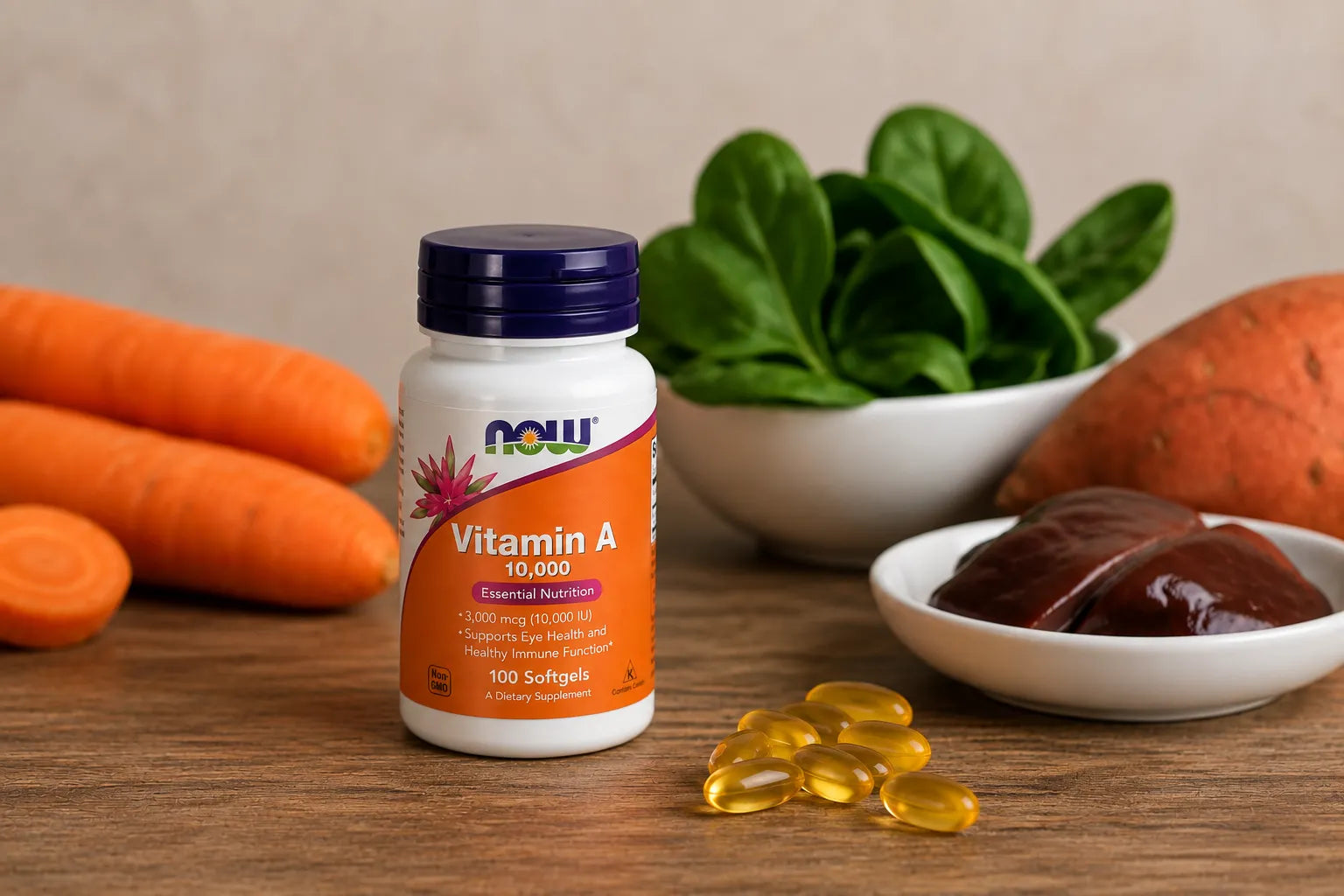
Preformed vitamin A (retinol and retinyl esters) comes from foods like liver, eggs, and dairy, and the body absorbs it directly. Provitamin A carotenoids, like beta-carotene from carrots and leafy greens, get converted into active vitamin A by the body as needed.
This distinction matters for safety. Preformed vitamin A can build up to toxic levels with excess intake, while carotenoids rarely cause toxicity since the body regulates how much it converts.
Vitamin A supports four main functions:
-
Vision: Essential for the light-sensing cells in the retina
-
Immune function: Helps maintain the skin and mucous membranes that form the body's first defense against infection
-
Skin health: Regulates skin cell turnover, which is why it appears in so many skincare formulations
-
Cell growth: Supports normal growth and development, particularly important during pregnancy
How Much Vitamin A Is Safe to Take Per Day?
Quick answer: Adult men need about 900 mcg RAE (3,000 IU) daily and adult women need about 700 mcg RAE (2,333 IU), with a safe upper limit of 3,000 mcg RAE (10,000 IU) daily for preformed vitamin A.
Going past the recommended amount is not automatically dangerous, since the upper limit exists as a ceiling with some buffer built in. But regularly exceeding it, especially over months, raises the risk of toxicity symptoms.
Recommended Daily Vitamin A Intake by Group
|
Group |
RDA (mcg RAE) |
RDA (IU) |
Upper Limit (IU) |
|
Adult men |
900 |
~3,000 |
10,000 |
|
Adult women |
700 |
~2,333 |
10,000 |
|
Pregnant women |
770 |
~2,565 |
10,000 |
|
Breastfeeding women |
1,300 |
~4,300 |
10,000 |
|
Children (4 to 8 years) |
400 |
~1,333 |
3,000 |
Pregnant women need to be particularly careful with preformed vitamin A specifically, since excess intake during pregnancy has been linked to birth defects. This is a different risk profile from beta-carotene, which does not carry the same concern.
Is It Safe to Take 50,000 IU of Vitamin A Daily?
Quick answer: No, 50,000 IU daily is far above the adult upper limit of 10,000 IU and should only be taken under direct medical supervision for a diagnosed deficiency, not as a general supplement.
This dose is sometimes prescribed short-term for confirmed vitamin A deficiency, under monitoring, but it is not a level anyone should self-administer. Sustained intake at this range has been associated with liver damage, bone density loss, headaches, and skin peeling.
If a healthcare provider has not specifically prescribed this dose for a diagnosed condition, this level of vitamin A supplements should be treated as a red flag rather than a wellness routine.
How Much Vitamin A for Dry Eyes?
Quick answer: Vitamin A deficiency can cause dry eyes, but supplementing beyond the standard RDA is not automatically the fix, and a doctor should confirm deficiency before increasing intake.
Vitamin A deficiency is a well-documented cause of dry eyes and, in severe cases, more serious eye conditions. But dry eyes in most people are caused by screen time, environmental factors, or other conditions unrelated to vitamin A levels at all.
Before assuming vitamin A is the answer:
-
Get a deficiency confirmed through blood testing rather than starting a high dose speculatively
-
Rule out common non-nutritional causes like screen exposure and low humidity
-
Stick to the standard RDA unless a doctor identifies a specific deficiency
-
Consider that other vitamins and minerals, such as omega-3 fatty acids, also play a documented role in eye moisture and comfort
Treating dry eyes with an unverified assumption about vitamin A deficiency risks missing the actual cause while pushing intake toward unsafe territory.
Can I Take Vitamin A Instead of Accutane?
Quick answer: No, over-the-counter vitamin A supplements are not a substitute for Accutane (isotretinoin), which is a prescription medication requiring medical supervision due to its potency and side effect profile.
Isotretinoin is derived from vitamin A, but it is manufactured and dosed as a distinct pharmaceutical, not a vitamin. The doses used in isotretinoin treatment are calculated specifically for that drug's therapeutic profile and are monitored closely with blood tests throughout treatment.
Taking high-dose vitamin A supplements alongside or instead of a prescribed treatment carries real risk:
-
Combining the two increases the risk of vitamin A toxicity significantly
-
Self-dosing vitamin A supplements does not replicate isotretinoin's clinical effect on acne
-
Isotretinoin requires monitoring for liver function and other markers that over-the-counter supplements do not include
Anyone considering acne treatment options should discuss this directly with a dermatologist rather than attempting to replicate a prescription treatment with a supplement.
What Are the Signs of Vitamin A Deficiency and Toxicity?
Quick answer: Deficiency commonly causes night blindness and dry eyes, while toxicity causes headaches, dizziness, and in severe cases, liver damage.
Both ends of the spectrum are worth recognizing, since vitamin A is one of the few vitamins where too much is a genuine concern, not just too little.
|
Condition |
Common Signs |
|
Deficiency |
Night blindness, dry eyes, frequent infections |
|
Mild toxicity |
Headache, nausea, dizziness, skin peeling |
|
Severe toxicity |
Liver damage, bone pain, blurred vision |
Final Word
Vitamin A plays a real role in vision, immunity, and skin health, but it is one of the vitamins where more is not automatically better. Staying within the standard RDA covers most people's needs, and any move toward higher doses, whether for dry eyes, acne, or general supplementation, is worth discussing with a doctor first rather than self-adjusting.
This article is for general information and does not replace personalized medical advice. Anyone considering vitamin A supplementation beyond standard dietary intake, especially at higher doses or alongside prescription treatments, should consult a healthcare provider first.
Absolutely. I’d keep the meta title focused on the main search intent and make the FAQs target common “how much/safe” queries. The daily amounts below align with current NIH guidance.
Frequently Asked Questions
How much vitamin A should I take per day?
Most adults need 700 mcg RAE per day for women and 900 mcg RAE per day for men. Pregnant women need 770 mcg RAE, while breastfeeding women need 1,300 mcg RAE daily.
What is the maximum safe amount of vitamin A per day?
For adults, the upper limit is 3,000 mcg RAE per day (about 10,000 IU) of preformed vitamin A from sources such as retinol and retinyl esters. This limit does not apply to beta-carotene and other provitamin A carotenoids.
Is 50,000 IU of vitamin A safe?
50,000 IU is far above the adult upper limit for preformed vitamin A and should not be taken routinely without medical supervision. Very high intakes can cause symptoms of vitamin A toxicity and, with prolonged exposure, serious health problems.
What are the symptoms of vitamin A deficiency?
Vitamin A deficiency can cause difficulty seeing in low light or night blindness and, in more severe cases, xerophthalmia and vision loss. Deficiency can also impair immune function and increase susceptibility to infections.
What are the signs of too much vitamin A?
Excess preformed vitamin A can cause headache, nausea, dizziness, blurred vision, muscle or joint pain, and other symptoms. Prolonged high intake can damage the liver and affect bone health.
Can vitamin A help with dry eyes?
Vitamin A deficiency can cause dry eyes and other eye problems, but dry eyes do not necessarily mean you are deficient. Taking high-dose vitamin A without confirmed deficiency is not recommended because excess preformed vitamin A can be harmful.
Is beta-carotene the same as vitamin A?
Beta-carotene is a provitamin A carotenoid that the body can convert into vitamin A. Preformed vitamin A, such as retinol, is already in a form the body can use. The safety limits for vitamin A supplements apply specifically to preformed vitamin A, not beta-carotene.
Can I take vitamin A instead of isotretinoin (Accutane)?
No. Vitamin A supplements are not a substitute for isotretinoin. Isotretinoin is a prescription medicine with a specific therapeutic dose and safety-monitoring requirements. Taking high-dose vitamin A in an attempt to reproduce its effects can increase the risk of toxicity.
Is vitamin A safe during pregnancy?
Vitamin A is essential during pregnancy, but high doses of preformed vitamin A can cause birth defects. Pregnant people should avoid high-dose preformed vitamin A supplements unless specifically directed by a healthcare professional.
Which foods are high in vitamin A?
Good sources include liver and other organ meats, eggs, dairy products, fish, and fortified foods. Plant foods such as carrots, sweet potatoes, spinach, and other green or orange vegetables provide beta-carotene and other provitamin A carotenoids.
