
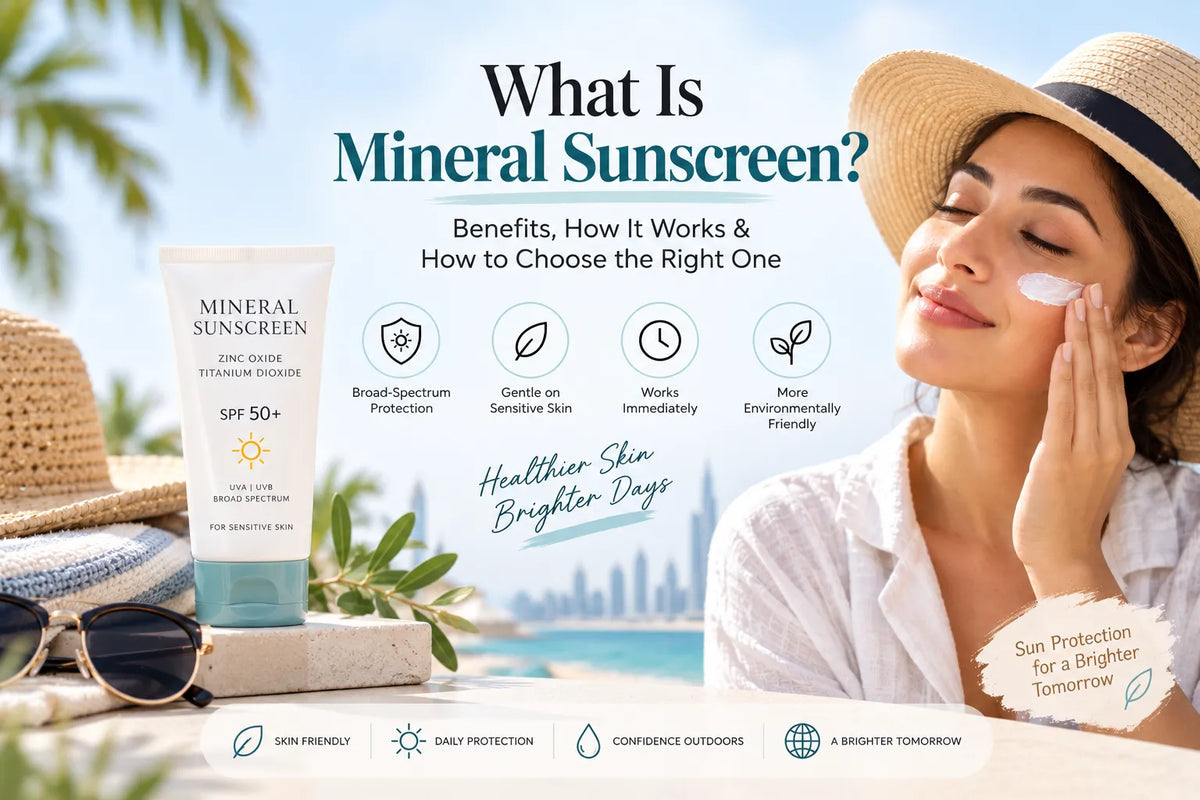
What Is Mineral Sunscreen? Benefits, How It Works & How to Choose the Right One
What Is Mineral Sunscreen?
Mineral sunscreen is a sun protection formula made from natural minerals, mainly zinc oxide and titanium dioxide. Instead of absorbing UV rays, it sits on the skin's surface and physically blocks or scatters them.
This makes it one of the gentlest sun protection options available today. Dermatologists often recommend it first for sensitive, acne-prone, or reactive skin types, especially in a climate as harsh as the UAE's.
How Does Mineral Sunscreen Work?
Mineral sunscreen works by forming a protective layer on top of the skin. Zinc oxide and titanium dioxide particles reflect and scatter UVA and UVB rays before they can penetrate the skin.
Think of it as a shield rather than a sponge. This is different from chemical sunscreen, which absorbs UV rays and converts them into heat that is then released from the skin.
Key points on how it functions:
-
Stays on the skin instead of soaking in
-
Can scatters and reflects and UV rays away from surface
-
Offers broad-spectrum protection against UVA and UVB
-
Remains stable in direct sunlight without breaking down quickly
Does Mineral Sunscreen Work Immediately?
Yes, mineral sunscreen starts working as soon as it is applied. There is no waiting period required before sun exposure.
This is one of its biggest practical advantages, especially for daily wear in the UAE where stepping outside even briefly means immediate UV exposure. Chemical sunscreens, by comparison, usually need around 20 to 30 minutes to bind with the skin and become effective.
What Is Chemical Sunscreen?
Chemical sunscreen uses organic compounds such as avobenzone, octinoxate, or oxybenzone to absorb UV radiation. The skin takes in these ingredients before converting UV rays into heat, which the body then releases.
Chemical sunscreens tend to feel lighter and blend in more easily, without the whitish cast some mineral formulas leave behind. However, they carry a higher chance of triggering irritation in sensitive or reactive skin, and some ingredients have raised environmental concerns.
How to Know If Sunscreen Is Mineral or Chemical
The easiest way to tell is by checking the active ingredients listed on the label.
|
Signs of Mineral Sunscreen |
Signs of Chemical Sunscreen |
|
Zinc oxide or titanium dioxide listed as active ingredients |
Avobenzone, octinoxate, octisalate, or oxybenzone listed |
|
Often labelled physical or mineral sunscreen |
Often labelled "chemical" or simply ‘sunscreen’ |
|
Slightly thicker texture, may leave a white cast |
Lightweight, blends in with no residue |
|
Effective immediately after application |
Needs 20 to 30 minutes to activate |
If the label lists zinc oxide or titanium dioxide as the only active ingredients, it is a mineral formula. Anything else on that list usually signals a chemical or hybrid sunscreen.
Benefits of Mineral Sunscreen
Mineral sunscreen offers a specific set of advantages that make it a preferred choice for many skin types in hot, sun-intensive regions.
-
Gentle on sensitive and acne-prone skin, with a low risk of irritation
-
Broad-spectrum protection against both UVA and UVB rays
-
Works immediately without needing time to activate
-
Less likely to clog pores or trigger breakouts
-
Generally considered safer for long-term daily use
For anyone searching for the best mineral sunscreen in UAE, these benefits matter even more given the intensity of UV exposure \here for most of the year.
Is Mineral Sunscreen Better for the Environment?
Generally, the more environmentally friendly sunscreen is mineral sunscreen than chemical sunscreen. Zinc oxide and titanium dioxide do not carry the same coral reef damage concerns linked to ingredients like oxybenzone and octinoxate.
Several marine conservation studies have flagged chemical UV filters as harmful to coral ecosystems. Mineral formulas, particularly non-nano versions, are often labelled reef-safe for this reason.
Mineral vs Chemical Sunscreen by Dermatologist Recommendations
Dermatologists generally recommend mineral sunscreen for specific skin concerns and chemical sunscreen for others, depending on individual needs.
Mineral sunscreen is typically advised for:
-
Sensitive or reactive skin
-
Rosacea or eczema-prone skin
-
Post-procedure skin, such as after chemical peels or laser treatment
-
Children and those wanting a gentler formula
Chemical sunscreen is often suggested for:
-
Oily or normal skin without sensitivity issues
-
Those who prefer a lightweight, invisible finish
-
Daily wear under makeup where texture matters most
Many dermatologists also recommend hybrid formulas that combine both types, offering the elegance of chemical sunscreen with a portion of mineral protection.
How to Choose the Right Mineral Sunscreen
Choosing the right formula depends on skin type, daily routine, and climate. A few factors are worth checking before buying.
-
SPF of 30 or higher for daily protection in high-UV climates
-
Broad-spectrum labelling to confirm UVA and UVB coverage
-
Non-nano zinc oxide for better environmental safety
-
A texture suited to your skin type, gel-based for oily skin and cream-based for dry skin
-
Water resistance if you are spending time outdoors or near water
In a climate like the UAE's, where sun exposure is intense for most of the year, reapplying sunscreen in UAE every two to three hours during outdoor activity matters just as much as the formula itself.
Final Word
Mineral sunscreen remains one of the most reliable, skin-friendly ways to stay protected from UV damage. It works instantly, suits sensitive skin, and carries fewer environmental concerns than many chemical alternatives.
Choosing the right one comes down to checking the label, matching it to your skin type, and applying it consistently.
FAQs
1. What is mineral sunscreen?
Mineral sunscreen is a type of sunscreen that uses mineral UV filters, mainly zinc oxide and titanium dioxide, to protect the skin from UVA and UVB rays.
2. How does mineral sunscreen work?
Mineral sunscreen forms a protective layer on the skin and uses zinc oxide or titanium dioxide to absorb, scatter, and reflect UV radiation before it can cause damage.
3. Does mineral sunscreen work immediately?
Yes. Mineral sunscreen provides protection as soon as it is properly applied to the skin, so it does not require a waiting period before sun exposure.
4. Is mineral sunscreen better than chemical sunscreen?
Neither type is universally better. Mineral sunscreen is often preferred for sensitive or reactive skin, while chemical sunscreen may offer a lighter, more invisible finish. The best option depends on your skin type and personal preferences.
5. Is mineral sunscreen good for sensitive skin?
Yes. Mineral sunscreen is generally considered a gentle option for sensitive, reactive, or acne-prone skin because zinc oxide and titanium dioxide are typically well tolerated.
6. Does mineral sunscreen clog pores?
Mineral sunscreen does not inherently clog pores. Choosing a non-comedogenic formula designed for acne-prone or oily skin can help reduce the likelihood of breakouts.
7. What should I look for in a mineral sunscreen?
Look for zinc oxide and/or titanium dioxide among the active ingredients. For everyday protection, also choose a broad-spectrum formula with an SPF of 30 or higher.
8. Does mineral sunscreen leave a white cast?
Some mineral sunscreens can leave a white or chalky cast, particularly formulas containing non-tinted zinc oxide or titanium dioxide. Tinted and newer formulations can reduce this effect.
9. Is mineral sunscreen reef-safe?
Mineral sunscreen is generally considered a more environmentally preferable option than sunscreens containing certain chemical UV filters. Non-nano zinc oxide is commonly chosen by consumers looking to reduce potential environmental concerns.
10. How often should I reapply mineral sunscreen?
Sunscreen should generally be reapplied at least every two hours when outdoors and more frequently after swimming, sweating, or towel drying. Reapplication is especially important during prolonged sun exposure.
